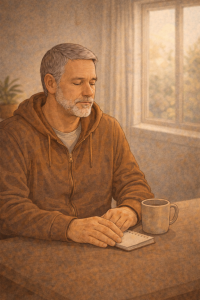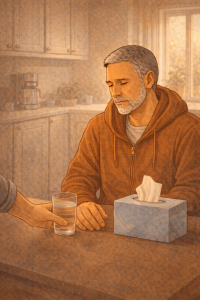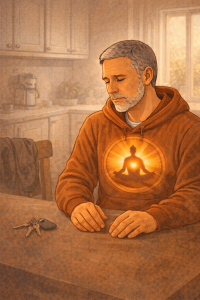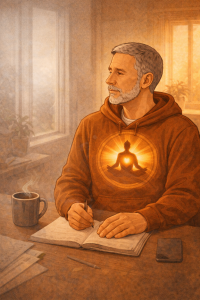
For a long time, New Year’s Eve felt loaded for me.
Not because of the drinking, oddly enough. Because of what kept happening around sobriety.
In early sobriety, I went to the New Year’s Eve sober dances. On paper, that sounds like a win. I was doing the “right” thing. I was showing up. I was staying sober. One year, I brought a date. We were meeting up with our usual crew. I don’t remember every detail, but I do remember this part clearly, my date left the dance with my buddy Mark.
That hurt.
The following year, the pattern repeated itself. The woman I was dating broke up with me at the New Year’s Eve sober dance.
Somewhere in there, my nervous system made a quiet note: this night is not safe.
New Year’s Eve stopped being about celebration and started being about waiting for something to go wrong.
Years later, after I was married, New Year’s Eve softened. We had what I think of now as “normal” New Year’s Eves. Nothing dramatic. Nothing symbolic. Just another night that turned into another year.
And for a while, that was enough.
Then, much later, New Year’s Eve came back with teeth.
From 2013 to 2017, I was in a relationship with a strange and painful pattern. We broke up every New Year’s Eve we were together. Sometimes quietly. Sometimes explosively. Once memorably. We were on a plane coming home from what I thought had been a fun vacation from Cuba. Midnight hit while we were in the air. I turned to her to wish her a Happy New Year and get a kiss. She broke up with me instead.
The final time she broke up with me was New Year’s Eve 2017 going into 2018. In the fall, I had been given an ultimatum: if I didn’t “have my act together” by midnight, we were done.
That moment mattered more than I knew at the time. Because that was the point where something in me finally broke open instead of just breaking.
I went to a psychiatrist and said, very plainly, “What the hell is wrong with me? Why do I keep going back to this?” When my EAP sessions ran out, she gently pointed me toward unresolved childhood trauma and recommended The Gatehouse.
That referral changed the direction of my life.
I didn’t suddenly love New Year’s Eve after that. Healing doesn’t work like flipping a switch. But I did start to understand something important.
It wasn’t the night I hated.
It was the pattern.
New Year’s Eve had become a mirror for abandonment, conditional love, and the old belief that I had to earn my place by performing, improving, or fixing myself on a deadline.
Midnight wasn’t a celebration. It was a verdict.
Over the last eight years, my New Year’s Eves have been quiet. At home. Often alone. No pressure. No countdown drama. No relationship hanging in the balance.
And here’s the part that makes me laugh now.
Three hundred and sixty-four nights a year, I can stay up until midnight, one a.m., sometimes much later.
But New Year’s Eve, the one night I’m “supposed” to stay up?
I’m usually asleep by ten.
These days, that feels like progress.
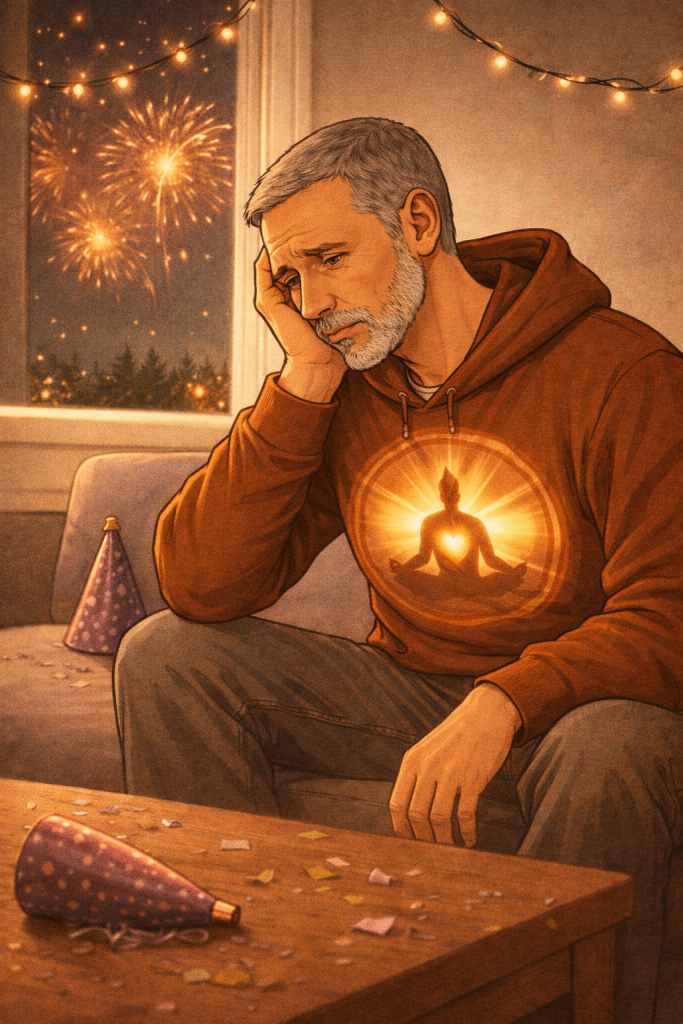
I’m single now, so there’s no risk of a midnight breakup. My big plan for New Year’s Eve 2025–2026 is to slip into my new comfy PJs and honestly just to try to stay awake until twelve.
If I make it, great.
If I don’t, also great.
Inside-out healing has taught me this: the goal isn’t to rewrite the past or force yourself to like what once hurt you. The goal is to stop letting old wounds run the present.
New Year’s Eve doesn’t get to judge me anymore.
It’s just another night. And I’m finally allowed to meet it on my own terms.
Closing Reflection Question
What expectations do I still carry into certain dates or moments, and what might change if I let them be just another day?