There are days when I know, intellectually, that what I’m watching unfold on my screen is not mine to fix.
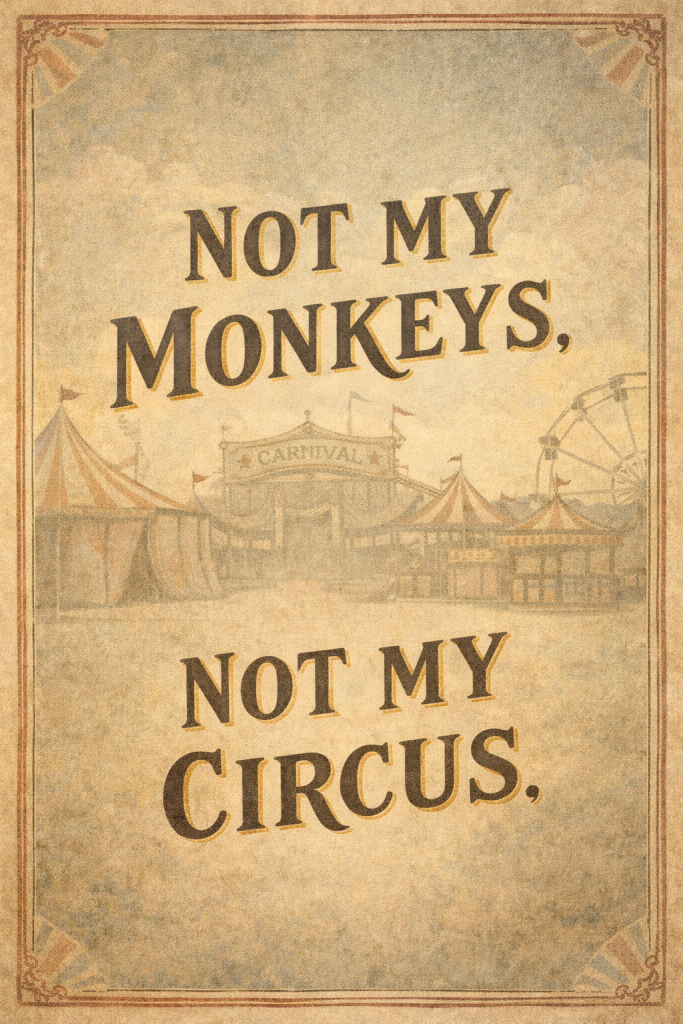
I know it’s not my monkeys.
I know it’s not my circus.
And still, my body doesn’t seem to get the memo.
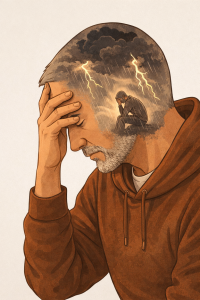
I can put the phone down, tell myself I’m safe, remind myself that nothing is happening in my living room right now. Yet my chest stays tight. My jaw stays clenched. My attention keeps drifting back to the news, the feeds, the next update.
If this sounds familiar, there’s nothing wrong with you.
When the world feels unstable, my nervous system goes into threat-monitoring mode. It scans for danger, for patterns, for anything that might help me stay ahead of whatever feels like it’s coming next. That system evolved to protect us from immediate, physical threats. A noise in the bushes. A storm on the horizon.
For me, that scanning doesn’t come from nowhere. It was shaped early, in a time when paying attention mattered. When safety wasn’t guaranteed. So when the world feels unpredictable now, my body reacts before my thinking mind has a chance to catch up, even when nothing in my immediate life is actually changing.
Logic arrives late to this party.
What our nervous systems were never built for is a constant stream of global uncertainty delivered in real time, with no pause and no clear endpoint. There’s no signal that says, “You’re safe now.” No sense of resolution. Just more input.
That’s not a discipline problem.
That’s biology under pressure.
Last week, I named this pattern. I even wrote about it. I called it what it felt like, an addiction to political news, the constant checking, the quiet belief that if I stayed informed enough, I might feel more in control.
Yet here I am again. Still checking. Still getting pulled in. Still feeling that familiar mix of urgency and helplessness.
There’s a part of me that wants to turn this into a failure story. I should know better. I already wrote about this. I’ve done enough work to be past it.
But that voice doesn’t actually help.
What feels truer is this: I recognize the loop now. I can feel it in my body. I can name what’s happening as it’s happening. And even though I’m not succeeding at stopping it yet, I’m no longer unconscious inside it.
That matters.
In recovery, relapse doesn’t always look dramatic. Sometimes it’s quieter. Sometimes it’s a return to old ways of regulating. Old ways of soothing anxiety. Old ways of trying to stay ahead of danger.
I’m not out of the loop yet. But I’m not pretending it isn’t a loop either.
That’s a different place to stand.
The real problem with doom-scrolling isn’t just the content. It’s the scale. Our nervous systems are small and local. They regulate best when life shows up in human-sized pieces. A room. A task. A conversation. Something with a beginning and an end.
Infinite feeds have no edges.
So part of healing, at least for me, has been learning how to gently shrink the world back down. Not by denying reality. Not by cutting myself off. But by bringing my attention back to what’s actually within reach today.
Regulation comes before insight.
Before I try to understand what it all means or what I should think about it, I have to help my body feel safer first. A regulated body can think. A dysregulated one just reacts.
A few things help, imperfectly but consistently.
I’m working today to try to contain my news intake instead of eliminating it. One or two intentional check-ins, with a clear start and a clear stop. Five minutes set with a timer. When the time is up, I step away on purpose. Not because I don’t care, but because I do.
I interrupt the loop through my body. Standing up. Stepping outside. Feeling cold air in my lungs. Not to calm my thoughts, but to change state. Presence matters more than calm.
And I choose finite activities when I can. Dishes get done. Walks end. Laundry gets folded. Completion tells the nervous system something scrolling never does, that something is finished.
None of this fixes the world.
What it does is make my world livable again.
I’m learning that I’m allowed to make my world smaller for a while. To focus on my health, my home, my relationships, my sobriety, my healing. I don’t have to carry everything that exists.
If all I can do today is get through today, that’s enough.
When the loop starts up again, and it will, I try to come back to something simple:
Nothing urgent is happening in this room.
I’m allowed to pause.
I can come back to this later.
Sometimes healing looks like putting the phone down, placing a hand on your chest, and choosing to live inside the size of your own life again.
That’s not avoidance.
That’s care.