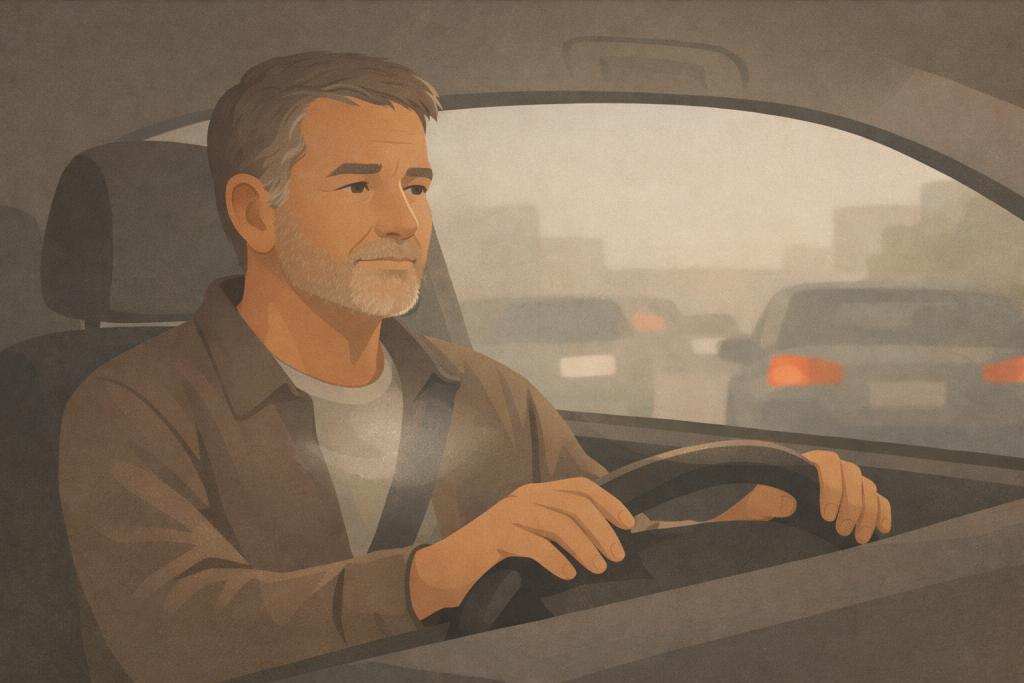
There was a time when my default reaction to everyday frustrations was irritation.
Not the dramatic kind. Just that low-grade, simmering annoyance that shows up when a pizza place runs out of garlic dip, a driver cuts you off, or someone parks their shopping cart sideways in the grocery aisle like they’ve personally declared sovereignty over Aisle 6.
My internal response was usually some version of: How dare this happen to me.
Nothing catastrophic. Nothing worth blowing up over. And yet, my nervous system didn’t know the difference. It reacted as if every small inconvenience was a personal insult. What changed things for me wasn’t learning to “be nicer” or pretending I wasn’t annoyed. It was learning to slow my reaction by just a fraction of a second.
I call it The Half-Second Rule.
What the Half-Second Rule Is
The Half-Second Rule is simple:
When something triggers you, don’t react immediately.
Take a breath.
Count silently.
Create just enough space to choose how you respond.
That half-second is where everything changes.
It’s not about suppressing emotion or forcing yourself to be calm. It’s about interrupting the automatic reaction long enough to let a more grounded response come online.
You still feel the irritation.
You just don’t let it drive the car.
Why This Matters More Than It Sounds
For a lot of men, myself included, frustration used to be my most familiar emotion. It was easier to access than sadness, fear, or vulnerability. Anger felt active. It felt protective. It felt justified.
But the truth is, most of my anger in public situations wasn’t about what was happening right now. It was about old patterns, old expectations, and an old belief that the world was constantly disrespecting me.
The Half-Second Rule helped me see that.
That tiny pause gave me a chance to notice what was actually happening, instead of reacting to what my nervous system thought was happening.
How It Looks in Real Life
This isn’t a theoretical tool. It shows up in the most ordinary moments.
- The pizza place is out of garlic dip.
Old response: irritation, sighing, passive-aggressive energy.
New response: pause, breath, choose another dipping sauce. - A driver cuts me off in traffic.
Old response: tension, muttering, maybe a very specific finger.
New response: pause, breath, full-hand wave. Not sarcastic. Just human. - Someone blocks the grocery aisle.
Old response: internal judgment, annoyance, silent resentment.
New response: pause, breath, “Excuse me, can I help you?”
Turns out she was struggling to reach something on the top shelf.
Nothing heroic happened in any of these moments.
But something shifted in me.
I stopped escalating my own stress over things that didn’t deserve it.
What’s Really Happening in the Pause
That half-second does a few important things:
- It tells your nervous system you’re not in danger
- It moves you out of reflex and into choice
- It reconnects you with your values, not your impulses
Most reactions happen fast. Responses take a moment.
And that moment is where dignity lives.
This Isn’t About Being Perfect
Let me be clear: I don’t get this right all the time.
I still catch myself reacting before I pause. I still feel irritation rise up. The difference now is that I notice it sooner, and I recover faster.
Progress here isn’t measured by never reacting.
It’s measured by how quickly you can come back to yourself.
A Simple Way to Practice
You don’t need a mantra or a breathing app to use this tool. Try this instead:
When you feel that familiar surge of irritation:
- Inhale slowly through your nose
- Count “one… two” silently
- Ask yourself, What response would I respect later?
That’s it.
Half a second.
One breath.
One choice.
Why I’m Sharing This
Inside-out healing isn’t about controlling the world around us. It’s about noticing what’s happening inside us and learning how to meet it with awareness instead of reflex.
The Half-Second Rule didn’t make me passive.
It made me more present.
And in a world that constantly invites us to react, that pause is one of the most powerful tools we have.