This is the first post in a new Meditation Monday series.
Before you click away because the word meditation makes you itch, hear me out.
This isn’t about emptying your mind.
It’s not about sitting cross-legged on the floor.
And it’s definitely not about being “good” at it.
This is a three-minute body check for men who feel better doing than sitting, and who often don’t notice how wound up they are until their jaw hurts or their shoulders feel like concrete.
If you’ve ever been told to “just relax” and felt your body tighten in protest, this is for you.
Why start with the body?
Most men live from the neck up.
We think our way through stress.
We power through discomfort.
We ignore the body until it yells.
The problem is, your body usually knows you’re not okay long before your brain admits it.
Restlessness.
Tight shoulders.
Shallow breathing.
A foot that won’t stop bouncing.
That low-grade buzz that never quite turns off.
This isn’t weakness. It’s a nervous system that’s been on duty for a long time.
A body check isn’t about fixing anything. It’s about noticing what’s already happening.
The rule
Three minutes. That’s it.
You don’t need silence.
You don’t need the perfect setting.
You don’t even need to sit still the whole time.
You just need to pause long enough to check in.
Minute 1: Where are you holding tension?
Stand, sit, or lean. Whatever works.
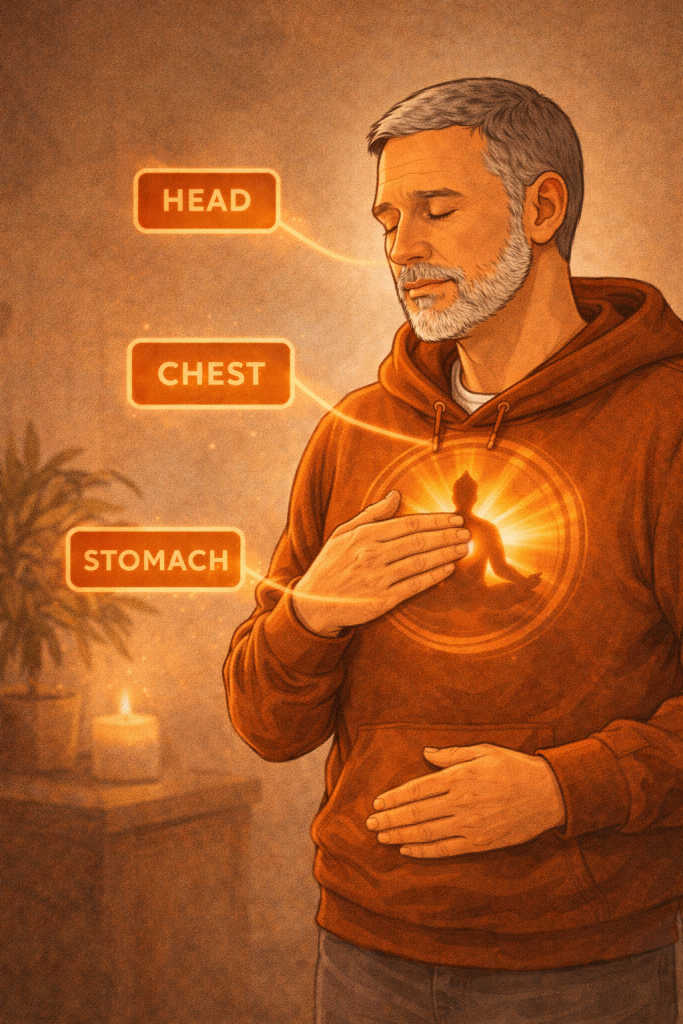
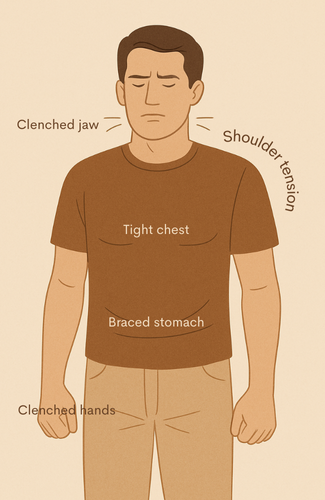
Start at the top of your head and slowly move your attention downward.
Not analyzing. Just noticing.
- Is your jaw clenched?
- Are your shoulders creeping up toward your ears?
- Is your chest tight or collapsed?
- Is your stomach braced like you’re expecting a punch?
- Are your hands clenched without realizing it?
You don’t need to change anything yet.
Just take inventory.
Most men are surprised by how much tension they’re carrying when they actually look.
Minute 2: Follow one breath
You don’t need to breathe “deeply” or “correctly.”
Just follow one breath from start to finish.
In through the nose or mouth.
Out however it comes out.
Then do it again.
Notice:
- Does the breath reach your chest, your belly, or stop high?
- Is it fast or slow?
- Smooth or choppy?
If your mind wanders, good. That’s normal. Bring it back to the next breath without giving yourself grief.
This isn’t about discipline. It’s about attention.
Minute 3: Ask one simple question
Ask yourself, quietly:
“What does my body need right now?”
Not what it should need.
Not what sounds productive.
Not what you think a therapist would say.
What does your body actually need?
Maybe it’s:
- A stretch
- A walk
- Water
- Food
- Rest
- A moment alone
- To stop pushing for five minutes
You don’t have to act on the answer immediately. Just notice what comes up.
Sometimes the answer is, “I don’t know.” That’s an answer too.
That’s it
No breakthroughs required.
No calm-as-a-monk expectation.
If all you noticed was, “Wow, I’m more tense than I thought,” the practice worked.
How to use this in real life
This body check works best when things feel slightly off, not when they’re already exploding.
Try it:
- Before opening your laptop in the morning
- In the car before going inside
- During a bathroom break
- When you feel restless but don’t know why
- When you’re about to snap and can’t explain it
Three minutes won’t solve everything.
But it can stop the spiral before it gains momentum.
A final word
Many men were taught to override their bodies early on.
Keep moving.
Don’t complain.
Push through.
This practice isn’t about becoming softer or slower.
It’s about becoming more aware.
And awareness is where real change starts.
Next Monday, we’ll build on this with another short, practical practice. No stillness medals awarded.
Just honest check-ins, one week at a time.