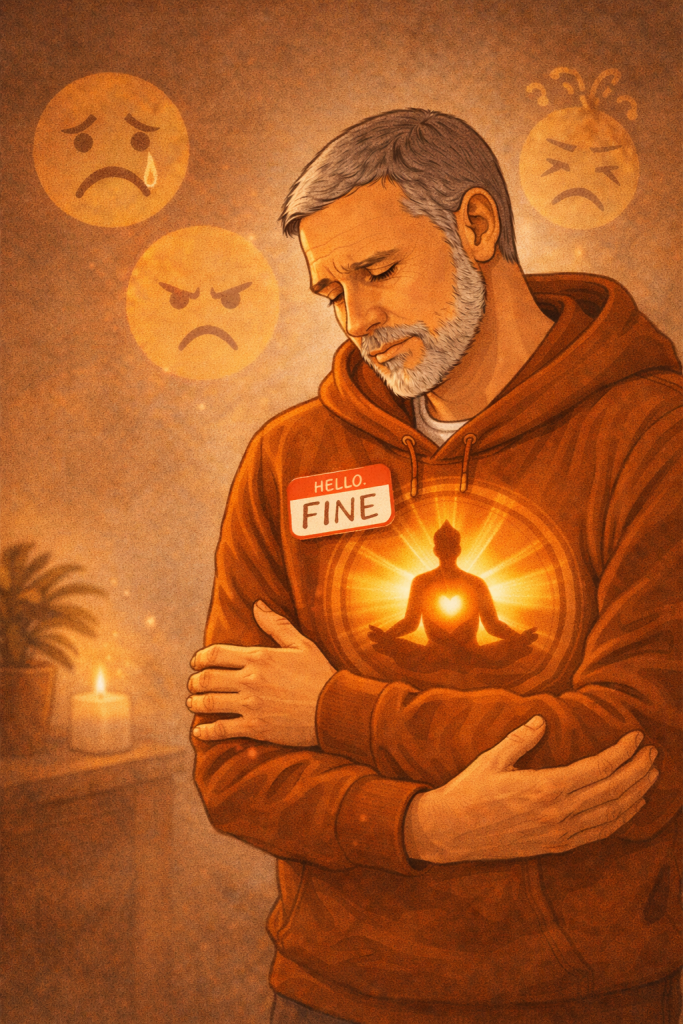
There are a lot of ways men hide what’s really going on inside them. Silence. Sarcasm. Busyness. Overworking. Over-helping. Over-drinking coffee. But the most common one, the most socially acceptable one, is a single word:
“Fine.”
“Fine” is the most popular lie men deliver with a straight face. Most of us only use the word honestly when we’re describing sandpaper. When a man says “I’m fine,” it usually does not mean fine.
It means:
- I don’t want to talk about this.
- I don’t have the words for what I’m feeling.
- I’m overwhelmed and trying to stay functional.
- If I stop moving, something is going to spill out.
“Fine” is vague on purpose. It keeps the conversation short. It keeps the attention off us. It buys us time, even when time is the one thing making it worse.
How “Fine” Shows Up in Real Life
You hear it everywhere once you start listening:
- “I’m fine, leave it.”
- “Fine. Whatever.”
- “It’s fine. I’m used to it.”
- And the classic closer:
“No really, I’m fine.”
Which practically guarantees the opposite.
Sometimes “fine” is defensive. Sometimes it’s exhausted. Sometimes it’s a white flag disguised as a thumbs-up.
In recovery circles, “FINE” has long had an unofficial translation:
Fucked up
Insecure
Neurotic
Emotional
Crude? Yes.
Accurate? Also yes.
A Lived Example (Because This Isn’t Theory)
For years, I thought “fine” meant I was coping.
I’d stopped drinking. I was showing up. Paying bills. Raising my family to the best of my ability. Doing the right things. If someone asked how I was doing, “fine” came out automatically.
But inside, I wasn’t fine. I was tight. Irritable. Restless. Discontent. Carrying things I hadn’t named yet.
After my divorce, people would check in and I’d say “I’m fine” because:
- I didn’t want to be a burden.
- I didn’t want to sound weak.
- I didn’t know where to start.
“Fine” became my way of staying upright while slowly grinding myself down.
It took time, and more than a few uncomfortable pauses, to realize that fine wasn’t protecting me. It was pressurizing me.
Why “Fine” Is So Dangerous
Here’s the quiet problem with “fine”:
It shuts the door before anything real can come through.
When you say “fine,” you don’t just end the conversation with others, you end it with yourself. You stop checking in. You stop listening. You stop noticing what your body is trying to tell you.
And pressure doesn’t disappear just because you refuse to name it.
It just looks for another exit.
Usually through anger. Or numbness. Or withdrawal. Or the body saying, “Hey buddy, if you won’t slow down, I will.”
Honesty lowers pressure. “Fine” raises it.
What to Say Instead (No Therapy Speak Required)
You don’t need to pour your soul out. You don’t need a five-minute emotional TED Talk. You just need slightly more honest words. Try these instead:
- “I’m stretched thin.”
- “I’m tired but managing.”
- “I’m carrying a lot right now.”
- “I’m not great, but I’m okay enough for today.”
None of these invite interrogation.
They simply tell the truth without pretending everything is smooth.
When I peer facilitate men’s CSA support groups at The Gatehouse, I’ve banned the word “fine.” Not because it’s evil, but because it isn’t a feeling. I want to know how you feel. As the saying goes, “You can’t heal if you don’t feel. “
You can’t work with “fine.” You can’t respond to it. You can’t build from it.
A Small Practice for Real Moments
Next time someone asks how you’re doing, pause for half a second longer than usual.
Check your body, not your script.
If “fine” is sitting there ready to jump out, try swapping it for one more accurate sentence. Just one.
You don’t owe anyone details.
But you do owe yourself honesty.
Because the most dangerous sentence a man can say isn’t “I’m falling apart.”
It’s: “I’m fine.”
And if you caught yourself nodding while reading this, yeah… me too.
You’re not broken.
You’re human.
And you’re allowed to say so.