I’ve never been good at asking for help.
Growing up in an alcoholic home, help wasn’t something you could count on. I learned early how to fend for myself and my siblings. I cooked dinners. I picked up my sister from school. I kept things running while my mom was passed out and my dad was off drinking.
By the time they were both gone in my late teens, I was already self-sufficient. Not in a proud, chest-out way. More in a quiet, survival way. I knew how to take care of myself because I had to.
That wiring stuck.
For most of my adult life, needing help felt like weakness. Accepting it felt worse. Even small things carried a strange charge, like I was failing some invisible test of strength.
Recently, something has been shifting.
As part of this move toward inside-out healing, I’ve been practicing not just asking for help, but accepting it when it’s offered, even when I didn’t ask.
That showed up clearly while I was sick.
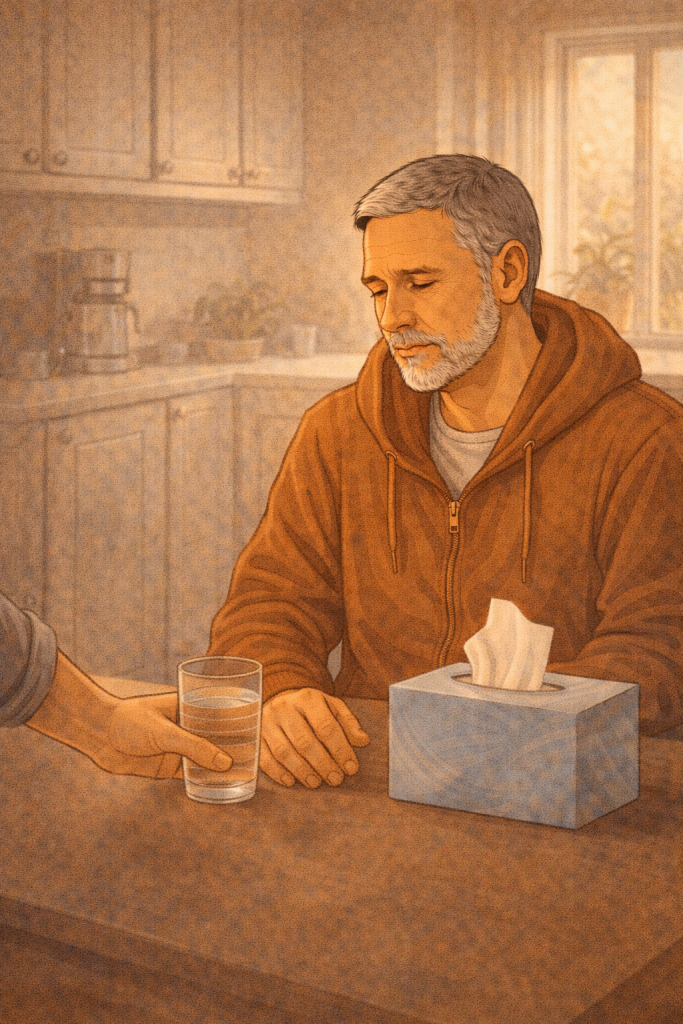
Megan offered to do little things. A glass of water. Tissues. Nothing dramatic. In the past, I would’ve waved it off automatically. “I’m fine.” “I’ve got it.” “Don’t worry.”
This time, I said yes.
And what surprised me wasn’t the relief. It was the absence of guilt. No shame about not being strong enough. No inner voice telling me I should be able to handle this on my own.
Just someone offering care, and me letting it land.
I’m realizing that refusing help was never about independence. It was about old conditioning. A nervous system that learned early, you’re on your own, so don’t expect anything.
Accepting help now doesn’t make me weaker. If anything, it feels like evidence that something inside me finally trusts that I’m not alone anymore.
Today, I’m sitting with this question:
Where in my life am I still pushing away care that’s already being offered?