I recently read an interview with Lydia Cornell where she was asked a familiar question:
Do you think addiction is an illness, a disease, a choice, or a wicked twist of fate?
Her answer stopped me cold:
“A spiritual malady rooted in childhood trauma.”
I’ve been saying some version of this to participants for a while now, but seeing it named so plainly, without defensiveness or debate, hit home.
Because for many adult survivors of childhood sexual abuse, addiction was never the original problem.
It was a solution.
I know why it landed so hard. It wasn’t just about the men I work with. It was about me.
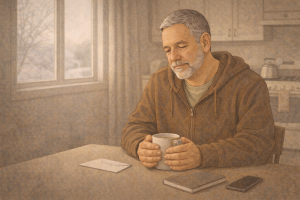
My first addiction didn’t start with alcohol. It started at ten years old, with coffee.
Strong. Black. On purpose.
I wasn’t drinking it for the taste. I was drinking it for the effect. I didn’t want to be in my skin. I needed an escape, or at least a shift, and coffee gave me just enough distance from myself to get through the day.
At ten.
That matters.
Because when we talk about addiction only as a disease, or a moral failing, or a bad choice, we miss something essential. We miss the fact that long before substances became destructive, they were adaptive.
They worked.
They regulated a nervous system that had learned early that the world wasn’t safe. They offered relief before there was language, support, or choice. They helped a child survive an internal state that felt unbearable.
For many adult survivors of childhood trauma, addiction isn’t the original wound.
It’s the response to it.
That doesn’t mean there’s no responsibility.
It doesn’t excuse harm.
But it radically changes the question.
Instead of “What’s wrong with you?”
We ask “What happened to you, and how did you learn to cope?”
Healing, then, isn’t just about stopping a substance or behaviour. It’s about learning how to stay present in a body that once needed escape. It’s about building tolerance for calm, for safety, for being here, without needing something to alter the moment.
Sobriety can remove the solution.
Healing helps us understand why we needed it in the first place.
That’s why that line resonated so deeply.
It named something quietly true.
Addiction wasn’t my problem.
It was my first attempt at relief.
From the inside out.